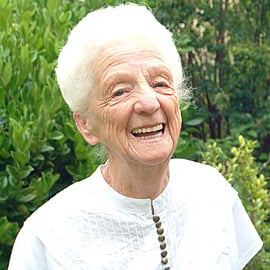
Love Your Heart - Alan Waddell
Meet Alan Waddell, a spritely 93-year-old Sydneysider who is leading the fight against heart disease on foot.
We can all make lifestyle changes to improve our heart health. And it's never too late to get started.
He's been called a ‘legend,' ‘Australia's Forrest Gump' and a ‘welcome dose of inspiration.' In fact, 93-year-old Alan Waddell has become quite the celebrity since deciding to undertake the extraordinary task of walking every street in Sydney's 641 suburbs five years ago following the sad death of his beloved wife of 60 years. Since then Alan's been an ambassador for the Heart Foundation, appeared on national television, been interviewed on radio, and featured in stories published in Australia and overseas. He even has his own website, www.walkingsydneystreets.net, which has been visited by almost half-a-million people from 168 countries and is growing in popularity every week.
After meeting Alan, it's easy to see why people are drawn to him. He's got a great sense of humour, and is thoroughly engaging as he recounts some of the highlights of his walking tour so far. Like the time he walked Dangar Island on the Hawkesbury River, north of Sydney, and was puzzled by the line-up of 20 to 30 wheelbarrows parked at the wharf. "You catch a ferry from Brooklyn to Dangar Island and you expect to see cars parked when you get there but there are no cars," he says. "At the wharf you'll see wheelbarrows. Residents and weekenders use the wheelbarrows to put their shopping in and things like that - it's fascinating."
Despite Alan's cult following, his remarkable walking mission is not about personal gain. It's about promoting the benefits of an active lifestyle at any age - a message he took on board after getting a wake-up call from the doctor about his own health. "I was told by my vascular surgeon that if I did not walk every day - in the wet, cold, heat or fine weather - I would be in a wheelchair. Well the wheelchair wasn't an option so I started to walk," says Alan. The retired accountant, who still saw some clients until recently, now walks for about 85 minutes a day, including a one-minute stop every 10 minutes in order to recover from a leg aneurysm. He's covered plenty of ground in his walking travels - 277 suburbs - which has put him in the good books with his cardiologist.
"Last time I saw my cardiac specialist, as far as he's concerned, I'm in great shape and could live until I'm 100," says Alan. "I encourage everyone to give walking a go for a fortnight, and they'll gradually get used to it and make it part of their lifestyle."
Alan's high profile has allowed him to spread the word on the merits of walking to a big audience and he's often asked to be a guest speaker at seniors' groups, schools and health organisations - a role he's happy to take up if it gives him the opportunity to give others a kick-start. "To give an example, I was recently invited to speak to a group who looks after people with diabetes and one lady came up to me and said, ‘You have inspired me. I do my best to walk every day and I know it will prolong my life.' If I've encouraged two people out of 20, I know I've done something," says Alan.
Along with his daily walking routine, Alan attributes his own good heart health to only having a "sip" of alcohol at weddings and not smoking. "I've never had a cigarette in my life and the doctors say this has helped keep me in the state I'm in at 93," he says. For Alan, who concedes he never really excelled at sport, the joy in what he's doing is as much about motivating others to make positive changes, just like he did, as it is about the journey of walking through Sydney's streets. "It's very nice to get over 500 emails from people around the world that say I've inspired them to give walking a go," says Alan.

Cardiovascular disease:
- Is heart, stroke and blood vessel disease.
- Kills one Australian every 10 minutes.
- Affects more than 3.5 million Australians.
- Prevents 1.4 million people from living a full life because of disability caused by the disease.
- Was suffered by one in six Australians in 2004, and affected two out of three families.
- Claimed the lives of almost 48,000 Australians (35 percent of all deaths) in 2004 - deaths that are largely preventable.
Five steps to reduce your risk of heart disease
- Be smoke-free. Stopping smoking is the single most important thing you can do to reduce your risk of coronary heart disease.
- Enjoy healthy eating - reduce the amount of saturated fat you eat. Saturated fat is found in fatty meats, full cream dairy products, butter, coconut and palm oils, most fried take-away foods and commercially baked products. Replace saturated fats with moderate amounts of monounsaturated and polyunsaturated fats such as canola, olive, sunflower and soybean oils.
- Be physically active. The body is designed to move, and regular physical activity is good for the heart. The Heart Foundation recommends 30 minutes or more of moderate intensity physical activity (such as brisk walking) on most days of the week. Try shorter bouts if more convenient i.e. three 10-minute walks.
- Control blood pressure - have regular blood pressure checks. If your blood pressure is high, reduce salt intake, limit alcohol to two drinks or less daily and follow your doctor's advice. Long-term medication may be required to manage high blood pressure.
- Maintain a healthy weight. Being overweight and carrying too much weight around the waist are risk factors for coronary heart disease and diabetes. Healthy eating and being physically active assists weight loss and in turn, is good for your heart.
What are the warning signs?
You may experience more than one of these symptoms:
- Pain in the chest. A heart attack usually causes discomfort or pain in the centre of the chest. The pain may come on suddenly, or sometimes starts slowly, developing over minutes. It may feel like tightness, pressure, heaviness, fullness, or squeezing. The feeling has been described as: ‘like a steel band tightening around my chest,' ‘like an elephant sitting on my chest,' or ‘like a red hot poker in the centre of my chest'. The pain may be severe, moderate or even mild.
- Pain spreading. The chest discomfort may spread to the neck and throat, jaw, shoulders, the back, either or both arms and even into the wrists and hands.
- Discomfort in the upper body. Some people do not get any chest pain - only discomfort in parts of the upper body. There may be a choking feeling in the throat. The arms may feel ‘heavy' or ‘useless.'
- Other symptoms. Often there may also be difficulty breathing, nausea or vomiting, a cold sweat or a feeling of being dizzy or light-headed.
Update: Alan passed away peacefully in early September 2008.
Other stories in this section:
- Conquering Loneliness with Pay TV
- Keeping Your Fitness as You Age - Use It at 55 or Lose it at 75
- Jeff Kennett and Beyond Blue
- Dementia and Alzheimer's
- Osteoporosis - Boost Your Bone Health Today
View all stories in Health and Wellness »
- What You Need to Know
- Industry Movers and Shakers
- Health and Wellness
- Travel and Lifestyle
- Learning and Technology
- Politics and Government
- Legal
- Finances and Work
- Senior Celebrities
Buy Villages Publications online
Your Questions Answered
Order your own State Villages.com.au Magazine
Missed us at your local pharmacist? Purchase your copy online with retirement villages, maps and questions answered. Just $6.95 delivered to your door.
Free eBook

Need an overview of retirement village life and the most common questions answered? Download Chris Baynes' easy to read 16 page guide for free now.